
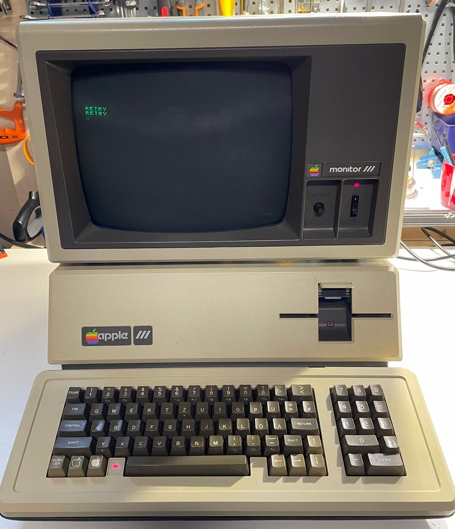
I have the main unit and Apple III monitor.
type computer
country USA
year 1980
os Apple SOS (Sophisticated OS)
cpu Synertek 6502A
speed 2 MHz
ram 128 MB
disk 143k 5,1/4″ floppy
graphic 280×192, 560,192
colors 16 colors, 16 Shares
sound yes
ports two serial ports, floppy port, composite video
The Apple III — Apple’s Most Troubled Machine
Released in May 1980, the Apple III was Apple’s attempt to create a serious business computer that would compete with the IBM PC and CP/M machines in the professional market. It was a commercial disaster — plagued by hardware failures, recalled, redesigned, and ultimately discontinued in 1984 having sold only around 65,000 units. Yet the Apple III is historically fascinating as a window into what Apple might have become had it succeeded in the business market before the Macintosh arrived.
Design and Ambition
The Apple III was more powerful than the Apple II in most respects: it used a faster 2 MHz 6502A processor, supported up to 512 KB of RAM, had a built-in clock/calendar (among the first personal computers to do so), and came with Apple’s own SOS (Sophisticated Operating System) — a genuinely advanced OS for its time, with file system support, device-independent I/O, and a memory management system. It was also designed for the business environment, with a proper numeric keypad and professional aesthetics.
The Hardware Failures
The Apple III’s downfall was largely self-inflicted. Steve Jobs insisted the machine operate without a cooling fan for aesthetic reasons — a decision that caused chips to overheat and work themselves out of their sockets. Apple’s initial advice to customers experiencing problems was to lift the computer several inches and drop it, hoping the chips would reseat themselves. Apple eventually recalled all 14,000 units shipped, redesigned the machine, and relaunched it in 1981 — but the reputation damage proved fatal.
Legacy
The Apple III’s failure pushed Apple toward the Lisa and Macintosh projects, ultimately producing the graphical user interface revolution. In that sense, the III’s failure may have been one of the most consequential product disasters in technology history — clearing the path for the Mac.