
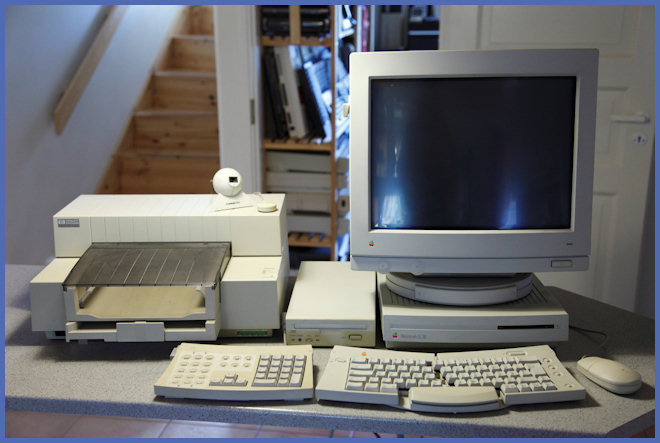
Apple Macintosh LC III
I have the main unit, Apple Machintosh 16″ color display, HP Deskwriter, RTM CD driver,
Connectix cam, Apple adjustable keyboard and Apple Desktop Bus Mouse II.
type computer
country USA
year 1993
os MAC OS 7.5.1
cpu 68030
speed 25 MHz
ram 4 MB
disk 1.44 MB
hd SCSI 80 MB
graphic 512 x 384 etc.
colors yes
sound beeper
ports ADB, video DB-15, SCSI DB-25, mic Omni, printer, modem, speaker
The Apple Macintosh LC — The Affordable Colour Mac
Released in October 1990, the Macintosh LC (Low Cost) was Apple’s first affordable colour Macintosh, designed specifically for the education market and home users who wanted colour capability at a price below the professional Mac II family. Using a 16 MHz Motorola 68020 processor, the LC could display up to 256 colours on an Apple 12-inch RGB monitor and offered a single LC PDS expansion slot for optional upgrades. Its pizza-box form factor — thin, wide, and designed to sit horizontally under a monitor — became the template for Apple’s affordable desktop Macs throughout the 1990s.
The Education Market
The LC was targeted primarily at schools, where Apple’s educational pricing made it accessible to institutions that could not afford the more expensive Mac II family. The machine proved enormously popular in American classrooms throughout the early 1990s, continuing the tradition the Apple II had established of making Apple the dominant computer in education. The LC’s ability to run an Apple IIe emulation card — allowing schools to continue using their existing Apple II software library — was a particularly thoughtful inclusion that smoothed the transition from Apple II to Macintosh in educational settings.
Technical Specifications
The LC used a 16 MHz 68020 processor with 2 MB of RAM (expandable to 10 MB), supported System 6.0.7 through System 7.1, and offered a built-in microphone — one of the first consumer Macs to do so. The single LC PDS expansion slot accepted a range of cards including the Apple IIe Card, additional video output cards, and various networking solutions. Despite the 68020’s limitations compared to the 68030 of higher-end Macs, the LC’s colour capability and low price made it a practical and popular choice for budget-conscious buyers.
The Apple Macintosh LC III — The Improved LC
Released in February 1993, the Macintosh LC III upgraded the successful LC and LC II with a 25 MHz Motorola 68030 processor — a significant improvement over the 16 MHz 68020 of the original LC. The 68030 added an integrated memory management unit (MMU) enabling virtual memory support under System 7, and the faster clock speed improved performance across all applications. The LC III maintained the pizza-box form factor and single LC PDS expansion slot of its predecessors while adding support for up to 36 MB of RAM.
The 68030 Advantage
The upgrade from 68020 to 68030 in the LC III brought meaningful real-world improvements. Virtual memory support allowed the machine to use hard drive space as supplementary RAM — important for running the increasingly memory-hungry applications of the early 1990s. The 68030’s on-chip caches also improved performance for common workloads, making the LC III noticeably faster than the LC II it replaced despite only a modest clock speed increase.
The LC Series in Education
The LC III was the most capable of the original LC pizza-box series and continued the model’s strong presence in educational markets. Apple’s educational pricing, combined with a growing library of educational software and the Mac’s intuitive interface, made the LC series the dominant computers in American schools throughout the early-to-mid 1990s. For many students of this era, the Macintosh LC was their first computing experience — and the machine that introduced them to the graphical interface that would define personal computing for decades.