
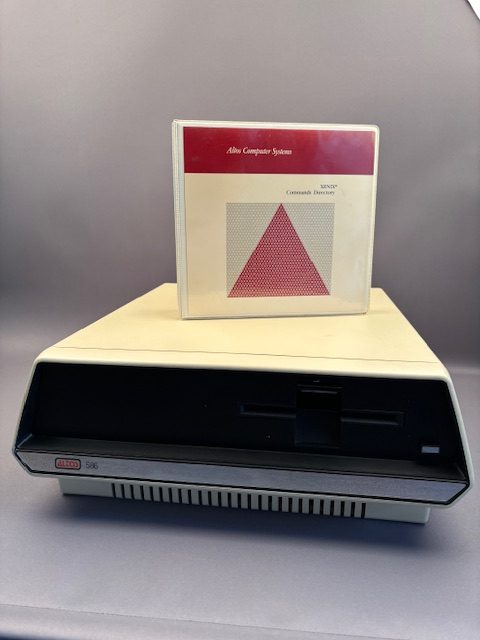
I have the main unit.
type computer
country USA
year 1983
os Microsoft Xenix or MP/M-86
cpu Intel 8086
speed 10 MHz
ram 512 KB
disk 5,25″ floppy disc
hd 10 MB
graphic text on terminal
colors no
sound no
ports serial (6), parallel
The Altos 586-10 was a powerful multi-user microcomputer released in the early 1980s by Altos Computer Systems. It was specifically designed for small businesses that needed a central system capable of supporting multiple terminals simultaneously.
1. Architecture and Processor
Unlike many home computers of the era that used 8-bit chips, the Altos 586 was built around the Intel 8086 16-bit processor, typically running at 8 MHz. This allowed the system to handle more complex tasks and manage multiple users more efficiently than its predecessors.
2. Multi-User Capabilities
The standout feature of the 586-10 was its ability to support up to 5 users (and later expandable even further). Users would connect to the main unit via ”dumb terminals” using serial RS-232 ports. This made it a cost-effective solution for offices, as they only needed one expensive central computer and several cheaper terminals.
3. Storage and Memory
The ”-10” in the model name usually referred to its storage capacity:
-
Hard Drive: It featured a built-in 10 MB hard disk, which was massive for the time.
-
Floppy Drive: A 5.25-inch floppy drive for backups and software installation.
-
RAM: It typically shipped with 512 KB of RAM, expandable up to 1 MB.
4. Operating Systems
The Altos 586 was versatile in its software support, often running:
-
Xenix: A version of UNIX developed by Microsoft, which was the preferred choice for multi-user business applications.
-
MP/M-86: A multi-user version of the CP/M operating system.
-
Pick OS: Known for its integrated database capabilities.
5. Networking and Legacy
Altos was a pioneer in local area networking. The 586 series supported Altos-Net and later Ethernet, allowing multiple Altos systems to be linked together. The 586-10 is remembered as a ”workhorse” that bridged the gap between expensive minicomputers and the emerging IBM PC market.
The Altos 586-10 — A Pioneer of Multiuser Unix Computing
The Altos 586-10, introduced in 1983 by Altos Computer Systems of San Jose, California, is a fascinating and historically significant piece of early business computing. At a time when most personal computers were single-user machines, the Altos 586 was designed from the ground up to serve multiple users simultaneously — running a full Unix-compatible operating system on a desktop-sized machine that cost a fraction of what traditional minicomputers demanded. It represents a pivotal moment in the democratisation of serious computing power for small and medium-sized businesses.
Altos Computer Systems — A Company Ahead of Its Time
Founded in 1977 in San Jose, California, Altos Computer Systems was one of the earliest companies to focus exclusively on multiuser microcomputers. While competitors like Apple and Commodore were targeting the home user and small office with single-user machines, Altos carved out a niche supplying cost-effective multiuser systems to businesses that needed several people to share a single computer simultaneously. By 1983, Altos had become the leading 8086-based Unix vendor in the world — a remarkable achievement for a relatively small company.
The company was eventually acquired by Acer in 1990, but its legacy in multiuser computing and Unix on microcomputers was firmly established by machines like the 586 series.
Hardware — The 586-10 Specifications
The Altos 586-10 was the mid-range model in the 586 series, with the ”10” designation referring to its 10 MHz Intel 8086 processor — a 16-bit CPU that represented the cutting edge of microprocessor technology in 1983. The base configuration came with 512 KB of RAM (expandable to 1 MB), a 12 MB hard drive, and a 1 MB 5.25-inch floppy disk drive. The machine launched at US$7,990 — roughly equivalent to $25,000 today — making it an investment aimed squarely at business customers rather than home users.
One of the 586’s most technically interesting features was its custom memory management unit (MMU). The Intel 8086 processor lacks built-in memory management functionality, so Altos designed their own MMU to handle memory protection and segmentation — essential for a true multiuser operating system where multiple users’ programs must be kept isolated from each other. This was sophisticated engineering that most competitors simply hadn’t attempted.
Connectivity was a key strength: the 586-10 came equipped with eight RS-232C serial ports as standard, expandable to sixteen, allowing up to eight simultaneous users to connect terminals to the system. A parallel printer port and Multibus adapter rounded out the expansion options. The machine also featured an Ethernet AUI port, making it one of the earliest microcomputers to offer built-in networking capability.
Software — Xenix and the Unix World
The Altos 586-10 ran Microsoft Xenix as its primary operating system — Microsoft’s own port of Unix to the x86 architecture, licensed from AT&T. This gave users access to the full Unix toolchain: the C programming language, shell scripting, pipes, file permissions, multi-process handling, and the entire ecosystem of Unix business software that had been developed for minicomputers. Optional operating systems included MP/M-86, OASIS-16, Pick, and MS-DOS, along with programming languages including BASIC, COBOL, FORTRAN, Pascal, and C.
The availability of such a broad software library was one of the 586’s greatest strengths. Businesses could run genuine Unix business applications — accounting packages, database systems, word processors, and vertical market software — on a machine that cost a fraction of a traditional minicomputer.
Industry Reception
The critical reception was outstanding. InfoWorld in November 1983 declared the 586 ”amazingly lightweight, full-featured, powerful and fast” — notably unusual praise given that the rest of the Altos product line had received more mixed reviews. BYTE magazine in August 1984 called it ”an excellent multiuser UNIX system” with ”the best performance” for the price among small Unix systems, reporting that a well-configured Altos 586 ”under moderate load approaches DEC VAX performance for most tasks.” The VAX was a $100,000+ minicomputer — comparing a $10,000 desktop machine favourably to it was extraordinary praise.
A March 1985 review noted that one user had run a multiuser bulletin board system on his 586 continuously, 24 hours a day, for over two years with no hardware failures — a testament to the machine’s reliability in demanding real-world use.
The 3Com Connection
The Altos 586 played an important role in the early history of computer networking. In spring 1983, 3Com — the networking company founded by Bob Metcalfe, inventor of Ethernet — offered the Altos 586 as a dedicated file server for their IBM PC networking solution. This made the 586 one of the first microcomputers to be used as a network file server in a commercial product, directly foreshadowing the client-server computing model that would define corporate IT for the next three decades.
Why It Matters
The Altos 586-10 is a machine that history has largely forgotten, overshadowed by the consumer revolution that IBM, Apple, and eventually Microsoft brought to computing. Yet in its day it represented something genuinely remarkable: Unix-class multiuser computing at a price point accessible to small businesses, delivered in a desktop package, with Ethernet networking built in. It was a glimpse of where serious computing was heading — client-server networks, Unix workstations, and shared computing resources — years before those concepts became mainstream. For any serious collection of computing history, the Altos 586-10 is a rare and significant artefact.