
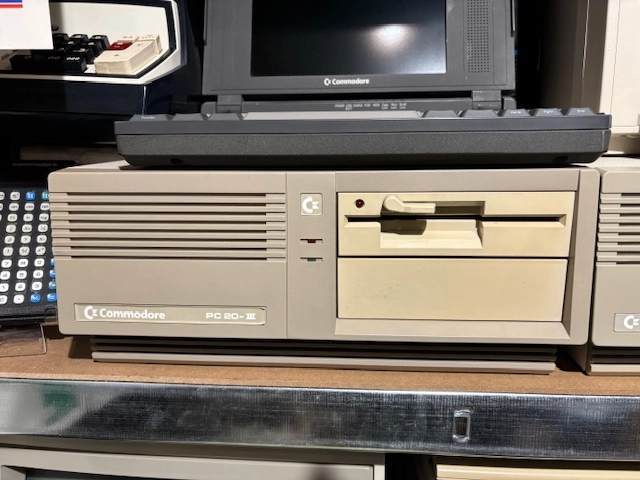
I have the main unit.
type computer
country USA
year 1988
os MS-DOS
cpu Intel 8088
speed 4.7 MHz
ram 640 KB
disk floppy 5,25″ 360 kB
hd 20 MB WD XTA
graphic CGA/Monochrome (Paradive PVC4)
colors yes
sound PC beeper
ports 8-bit ISA (3), composite video, mouse, RGB, serial, parallel
The Commodore PC 20-III is a classic piece of computing history from the late 1980s. While Commodore is legendary for the C64 and the Amiga, they also produced a successful line of IBM PC clones to compete in the professional and home office markets.
The ”PC 20” series specifically denoted models that came equipped with a hard drive—a luxury at the time!
### Technical Specifications
The PC 20-III was an ”XT-class” machine, meaning it was compatible with the original IBM PC/XT architecture but offered better integration and a smaller footprint.
| Component | Specification |
| CPU | Intel 8088-1 running at 4.77 MHz or 9.54 MHz (Turbo mode) |
| RAM | 640 KB (The maximum ”base memory” for DOS) |
| Hard Drive | 20 MB RLL or MFM Drive |
| Floppy Drive | 1 x 360 KB 5.25″ drive |
| Graphics | Built-in AGA (Advanced Graphics Adapter) supporting Hercules, CGA, MDA, and Plantronics modes |
| OS | MS-DOS 3.2 or 3.3 (Commodore branded) |
### Key Features
-
The ”Turbo” Switch: Unlike the original IBM PC, the PC 20-III allowed you to nearly double the clock speed from the standard 4.77 MHz to 10 MHz. This made a significant difference in spreadsheet calculations and early games.
-
Integrated Graphics: One of its best selling points was the AGA chipset. Instead of needing separate expensive cards for different monitors, the PC 20-III could handle monochrome (Hercules) or color (CGA) out of the box.
-
Small Footprint: By the time the ”-III” revision was released, Commodore had miniaturized the motherboard. It was much sleeker and more compact than the ”lumbering” IBM towers of the era.
-
Expansion: Even with its smaller size, it featured three 8-bit ISA expansion slots, allowing users to add modems, sound cards (like the early AdLib), or specialized controllers.
### Historical Context
The PC 20-III was popular in Europe, particularly in Germany and Scandinavia. It was marketed as a reliable, ”no-nonsense” business machine. While it lacked the incredible sound and color palettes of its cousin, the Amiga 500, it was the machine you bought if you needed to run WordStar, Lotus 1-2-3, or dBase.
Today, it is a favorite among retro-collectors because of its high build quality and its unique ”Commodore” take on the otherwise beige world of PC clones.
Fun Fact: The PC 20-III motherboard is virtually identical to the Commodore PC 10-III. The only real difference between the two models was that the PC 20 included the 20 MB hard drive, whereas the PC 10 was a dual-floppy system.