
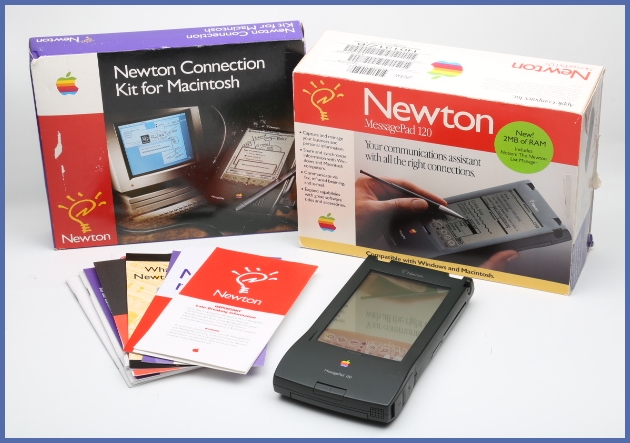
Apple Newton MessagePad 120
I have main unit (CIB) and Newton Connection Kit for Macintosh (CIB).
type handheld computer
country USA
year 1994
os NewtonOS 1.3
cpu ARM 610
speed 20 MHz
ram 1 MB
graphic 320x 240
color b/w
sound beeper
ports pcmcia
battery 4x AA 12h
The Apple Newton MessagePad 120 — The Original Personal Digital Assistant
Released in 1994, the Apple Newton MessagePad 120 was one of the most ambitious and influential personal technology products of the 1990s. As Apple’s dedicated personal digital assistant (PDA), it introduced handwriting recognition, a pen-based interface, and intelligent assistant features to consumer electronics — concepts so far ahead of their time that the technology needed a decade to catch up with the vision. The Newton’s handwriting recognition was notoriously imperfect at launch, inspiring parody in The Simpsons and Doonesbury, but its fundamental concept directly foreshadowed the smartphone revolution.
The PDA Vision
John Sculley, Apple’s CEO who coined the term ”Personal Digital Assistant,” envisioned the Newton as the foundation of a new category of computing — one that would be as transformative as the personal computer itself. The Newton platform’s sophisticated Newton Object System (NOS) operating system, intelligent assistant features, and object-oriented programming model were genuinely innovative for 1993. The MessagePad 120’s improvements over the original MessagePad 100 included better handwriting recognition through software updates, more memory, and a faster ARM 610 processor running at 20 MHz.
ARM Processor Significance
The Newton MessagePad 120 used the ARM 610 RISC processor — a chip developed by Advanced RISC Machines, the company spun out of Acorn Computers. Apple was one of the founding investors in ARM, and the Newton was among the first consumer products to use ARM processors outside of Acorn’s own computers. The ARM architecture’s combination of performance and power efficiency made it ideal for battery-powered handheld devices — and went on to become the most widely deployed processor architecture in history, powering virtually every smartphone today.
Legacy
The Newton was discontinued in 1998 when Steve Jobs returned to Apple, but its influence on subsequent products — most directly the iPhone and iPad — is unmistakable. Many Newton engineers went on to work on the original iPhone, bringing their experience with touch interfaces and intelligent assistants to a product that finally realised Newton’s vision with the technology to match.