
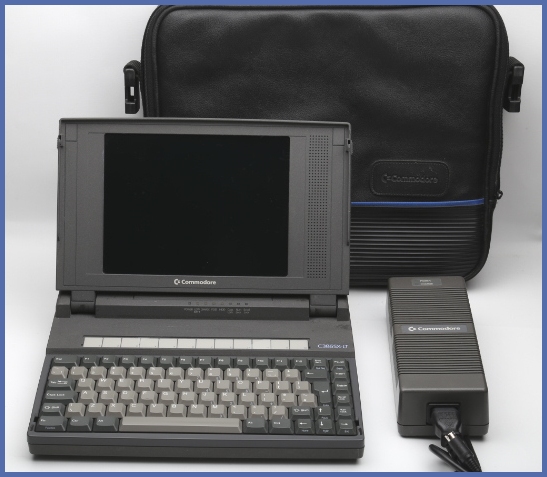
I have the main unit, power adapter and Carrying Case.
type computer
country USA
year 1990
os MS DOS
cpu Intel 386SX
speed 16 MHz
ram 1 MB
disk 3,5″ 1,44MB
hd IDE 20 MB
graphic 640×480
colors 24-bit (16,7 million)
ports parallel, serial, VGA, expansion
The Commodore C386SX-LT — Commodore’s PC-Compatible Laptop
The Commodore C386SX-LT was part of Commodore’s range of IBM PC-compatible laptop computers produced in the late 1980s and early 1990s — a recognition that the IBM PC architecture had become too dominant to ignore, even for a company with Commodore’s unique product portfolio. Using an Intel 386SX processor, the machine offered full DOS compatibility in a portable package, targeting the business market that was increasingly standardising on IBM PC-compatible hardware and MS-DOS software.
Commodore’s PC Strategy
Commodore’s decision to produce IBM PC-compatible machines alongside the Amiga and C64 reflected the commercial reality of the late 1980s computing market. While the Amiga was technically superior for multimedia and the C64 dominated gaming, the business market had converged almost entirely on DOS-compatible machines. Commodore’s PC-compatible range — including desktop machines and laptops — attempted to capture business sales that would otherwise go entirely to Compaq, IBM, and Asian clone manufacturers.
The 386SX in a Laptop
The Intel 386SX processor was Intel’s cost-reduced variant of the 386DX, using a 16-bit external bus rather than the full 32-bit bus of the DX while maintaining full 386 instruction set compatibility. This made it ideal for laptop use — lower cost, lower power consumption, and adequate performance for the DOS business applications of the era. The C386SX-LT running MS-DOS could run the full range of office productivity software including Lotus 1-2-3, WordPerfect, and dBASE that corporate users required.
Historical Context
The C386SX-LT represents a fascinating contradiction in Commodore’s product history — a company known for innovative, non-compatible platforms producing a thoroughly conventional IBM clone. It illustrates the irresistible gravitational pull of the PC standard in the late 1980s, which ultimately drew even the most innovative manufacturers into producing compatible hardware alongside their proprietary systems.