
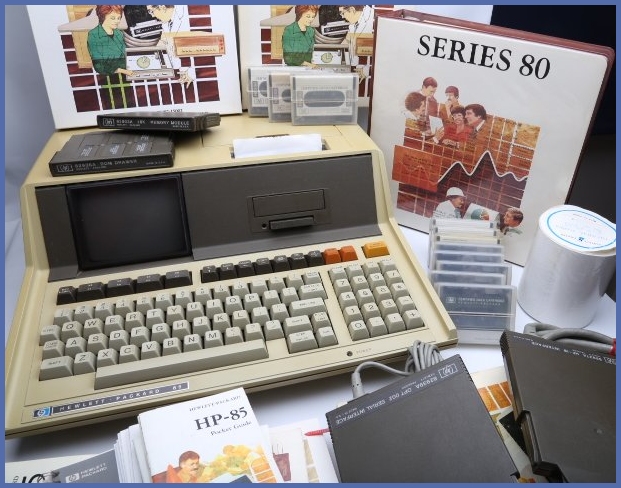
Hewlett-Packard 85
I have the main unit, 16 K Memory Module, Serial Interface, HP-1B Interface, ROM Drawer (Plotter-printer, Input/output, Matrix, Mass Storage), Thermal Paper and many HP200 Data Cartridges.
type computer
country USA
year 1980ds
os ROM-based Basicdsd
cpu HP Capricorn
speed 0,6 MHz
ram 16 KB
rom 32 KB
tape DC-100cartridges 210 KB
graphic 5″ CRT, 16×32, 256×192
colors mono
printer thermal
ports module slots (4)
The Hewlett-Packard HP-85 — Where Calculators Became Computers
Introduced in January 1980, the Hewlett-Packard HP-85 occupies a unique position in computing history as the machine that marked the transition from HP’s celebrated calculator heritage to its personal computer future. The HP-85 was HP’s first product explicitly marketed as a ”personal computer” — yet it retained deep roots in the calculator tradition, using a proprietary HP processor, running HP BASIC, and targeting the engineering and scientific market that HP had served so effectively with its calculator line since the HP-35 of 1972.
The Capricorn Processor
The HP-85 was built around an HP-proprietary 8-bit CMOS processor codenamed ”Capricorn,” running at just 625 kHz — a modest clock speed by the standards of the era, but one that reflected HP’s design philosophy of precision over raw speed. The Capricorn used a 64-bit internal data bus optimised for floating-point arithmetic, giving the HP-85 exceptional numerical precision for scientific calculations. BYTE magazine wrote of the HP-85: ”we were impressed with the performance… the graphics alone make this an attractive alternate to existing small systems on the market.”
All-in-One Scientific Workstation
The HP-85 packed an extraordinary amount of functionality into its typewriter-style desktop case. A 5-inch CRT displayed 16 lines of 32 characters or 256×192 pixels of graphics. A built-in DC-100 cartridge tape drive provided 210 KB of storage at 650 bytes per second. A thermal printer could reproduce anything shown on the screen. And 16 KB of RAM (expandable to 32 KB on the HP-85B) ran the HP BASIC interpreter stored in 32 KB of ROM. At $3,250 at launch, it was expensive — but it delivered laboratory-quality computing in a self-contained package that required no peripheral setup.
The Bridge Between Eras
The HP-85 arrived at a pivotal moment — announced in December 1979, just as the personal computer revolution was beginning. The IBM PC was still two years away, and the Apple II was barely three years old. The HP-85 served the engineering and scientific community that would increasingly need computing capability on their desks rather than in dedicated computer rooms, providing a bridge between the calculator-based computing of the 1970s and the personal computer era of the 1980s.