
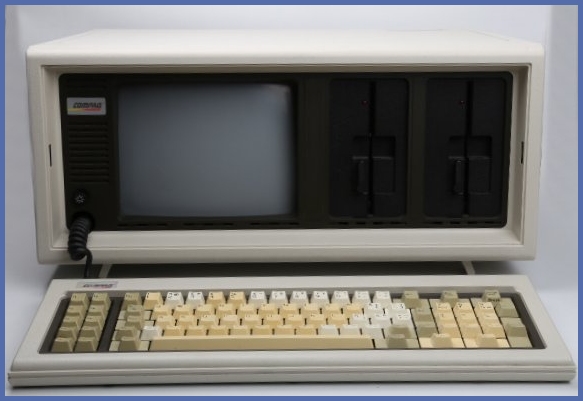
I have two main units.
type computer
country USA
year 1983
os MS-DOS
cpu Intel 8088
speed 4,77 MHz
ram 128 KB
disk 2* 5,1/4″ 320 KB
hd 20 MB
graphic built-in 9″ mono monitor
colors monochrome
sound beeper
ports parallel
The Compaq Portable — The Machine That Broke IBM’s Monopoly
Released in March 1983, the Compaq Portable was the first fully IBM PC-compatible portable computer — and the machine that set in motion a chain of events that permanently ended IBM’s dominance of the personal computer industry. Founded by Rod Canion, Jim Harris, and Bill Murto — three former Texas Instruments senior managers who each invested $1,000 to start the company — Compaq’s name derived from ”Compatibility and Quality.” Their first product proved both: a 13 kg luggable computer that ran every piece of IBM PC software perfectly and set a first-year revenue record of $111 million that stood as the highest in US corporate history for years.
The Legal Clone
What made the Compaq Portable remarkable was not just its portability but how it achieved IBM compatibility. Earlier clone attempts had reverse-engineered IBM’s BIOS illegally; Compaq’s engineers used a clean-room process — one team documented exactly what IBM’s BIOS did functionally, another team wrote a new BIOS from scratch that matched that behaviour without copying a single line of IBM code. This legally unassailable approach gave Compaq complete IBM compatibility without IBM’s intellectual property, establishing the legal framework that allowed dozens of other clone manufacturers to follow and ultimately created the open PC ecosystem that defines computing today.
Specifications
The Compaq Portable used an Intel 8088 processor at 4.77 MHz — identical to the IBM PC — with 128 KB of RAM expandable to 640 KB, an integrated 9-inch monochrome CRT display, one or two 5.25-inch floppy drives, and an optional 10 MB hard drive. It weighed approximately 13 kg — genuinely luggable rather than truly portable, but practical for carrying between offices and travelling on business. The integrated display and keyboard made it self-contained in a way that desktop PCs were not.
Historical Legacy
Compaq became the fastest company in history to reach $1 billion in sales (achieved in 1987) and ultimately grew to be the world’s largest PC manufacturer before its acquisition by Hewlett-Packard in 2002 for $25 billion. The Compaq Portable’s success demonstrated that IBM’s PC standard could be legally cloned, opening the door to the competitive PC market that drove prices down and computing power up throughout the 1980s and 1990s.