
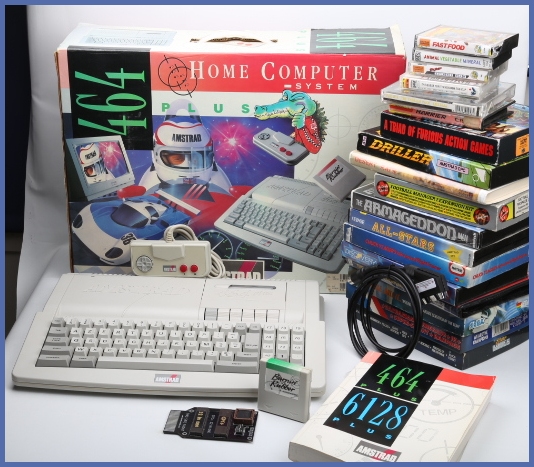
I have main unit (CIB)
type computer / Game Console
country UK
year 1990
os Locomotive Basic 1.1
cpu Zilog Z80A
speed 4 MHz
ram 64 KB
graphic 160 x 200 (16), 640 x 200 (2)
colors 31 max
sound 3 stereo voices, 8 octaves
ports light pen port, sound output, centronics, expansion, RGB din, cartridge, joystics (2)
The Amstrad CPC464 — Britain’s Affordable Computing Revolution
Launched on 11 April 1984, the Amstrad CPC464 was one of the most consequential home computers ever produced in Britain. Created by Sir Alan Sugar’s Amstrad company, the CPC464 did something that competitors had failed to achieve: it delivered a genuinely complete, ready-to-use computing package — keyboard, cassette deck, monitor, and software — at a price that ordinary families could afford. More than 2 million units were sold, making it one of the best-selling computers in European history.
Origins — The ”Plug In and Play” Philosophy
In the early 1980s, home computing was fragmented and frustrating for ordinary users. The Sinclair ZX Spectrum and Commodore 64 were popular but required a separate television as a monitor and a separate cassette player for loading software — a tangle of cables and compromises. Alan Sugar’s insight was simple and brilliant: include everything in one box. The CPC464 came with its own dedicated monitor (either a colour CTM640 or green-screen GT64), had the cassette deck built into the machine itself, and required only a single power plug. You unpacked it, plugged it in, and it worked.
The name CPC stood for ”Colour Personal Computer,” and the 464 referred to its 64 KB of RAM. Amstrad’s manufacturing efficiency allowed it to launch at £359 with the colour monitor — significantly less than comparable setups from Sinclair or Commodore once monitors and peripherals were included.
Hardware
The CPC464 was powered by a Zilog Z80A processor running at 4 MHz. It came with 64 KB of RAM and 32 KB of ROM containing Locomotive BASIC, one of the finest BASIC interpreters of the 8-bit era. The machine offered three display modes: 160×200 pixels with 16 colours, 320×200 pixels with 4 colours, and 640×200 pixels in 2 colours. Sound was handled by the AY-3-8912 chip, providing 3 voices across 8 octaves — richer than the Sinclair Spectrum’s single-channel buzzer.
Software and Gaming
The CPC464’s software library was vast. Major publishers including Ocean, Activision, US Gold, and dozens of others supported the platform with ports of arcade hits and original titles. Legendary CPC games included Roland on the Ropes, Head Over Heels, Batman, Dizzy, and Ghostbusters. The built-in Locomotive BASIC made it excellent for programming education, and CP/M compatibility via a disk interface opened access to serious business software.
Legacy
The CPC family sold over 3 million units in total and dominated the home computer market in France, Spain, and several other European countries. The Computer Museum Ata collection includes two CPC464 units with colour monitors CTM640, a tape drive, printer Seikosha SP-1000CPC, and an additional disk drive — a beautifully complete example of the platform as experienced in its heyday.
The Amstrad CPC464 Plus — The Last CPC, A Hybrid Between Computer and Console
Released in 1990, the Amstrad CPC464 Plus was Amstrad’s final and most ambitious attempt to revitalise the aging CPC platform. Coming six years after the original CPC464 and facing fierce competition from the 16-bit Amiga and Atari ST, the Plus models represented a bold redesign that transformed the CPC into a hybrid machine capable of functioning as both a home computer and a game console with a ROM cartridge slot.
Hardware Improvements
The CPC464 Plus retained the Zilog Z80A processor at 4 MHz but introduced substantial graphics enhancements. A new hardware sprite system allowed up to 16 hardware sprites simultaneously — entirely absent from the original CPC. The colour palette expanded from 27 to 4,096 colours (32 displayable simultaneously), and DMA sound channels were added for improved audio. The overall build quality was sleeker and more modern than the original CPC design.
Most significantly, the Plus models introduced a cartridge port compatible with the simultaneously-released GX4000 game console. Cartridge games loaded instantaneously and pushed the hardware to its limits. The Computer Museum Ata holds a CIB (Complete In Box) example — particularly desirable given the relatively short production run of the Plus models.
The GX4000 Connection
The CPC464 Plus launched alongside the GX4000 — Amstrad’s dedicated game console using the same cartridge format, essentially a CPC Plus without keyboard and disk drive. While the console was a commercial disappointment, it made the CPC Plus something unique: a home computer that was also a fully compatible game console.
Legacy
The CPC Plus models are today among the most sought-after 8-bit computers, prized for their enhanced hardware and relatively small production numbers compared to the original CPC range.