
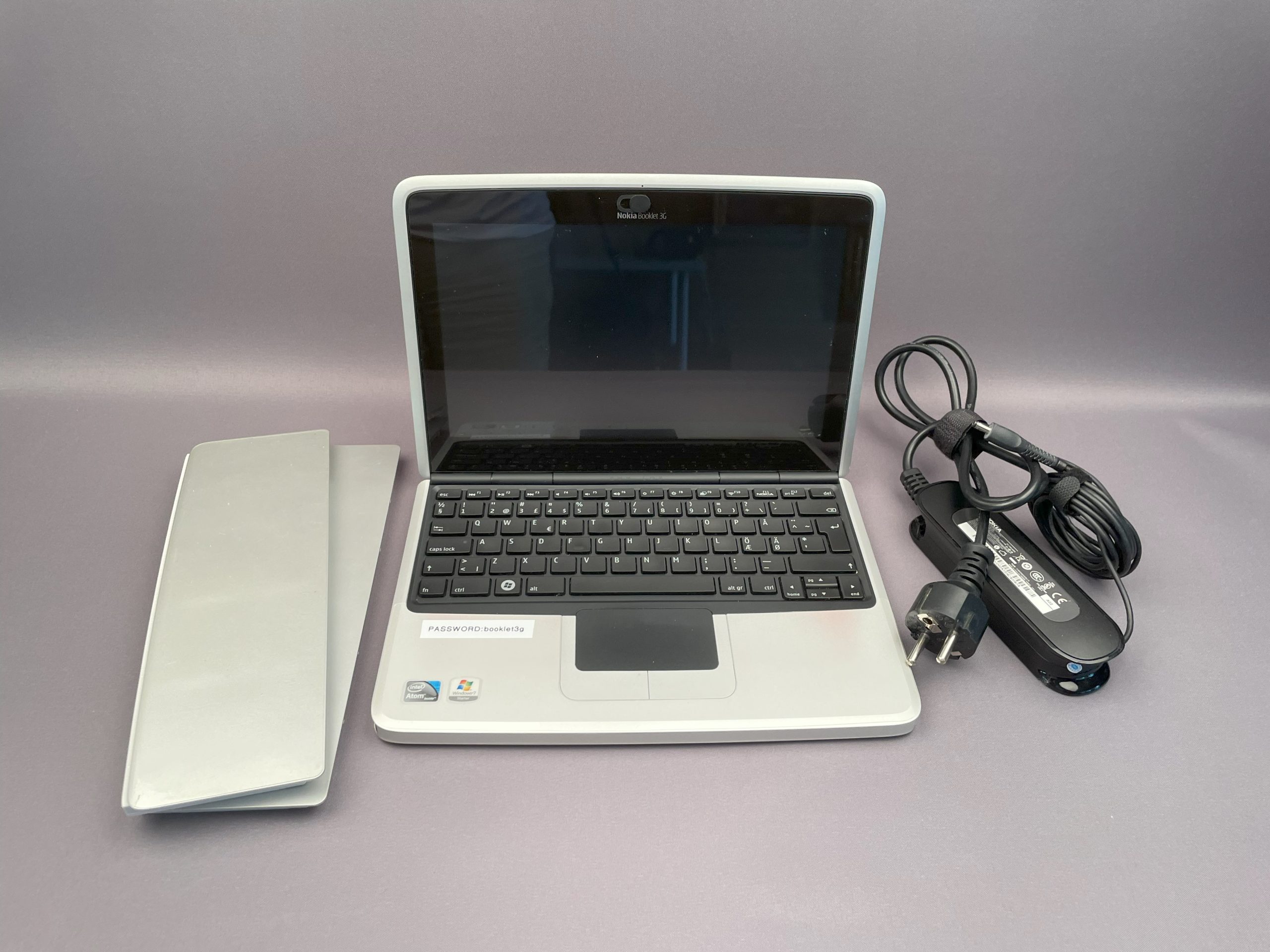
I have main unit and power adapter.
type computer
country Finland
year 2009
os Windows 7
cpu Intel Atom Z530
speed 1.6 GHz
ram 1 GB
hd 120 GB SATA
graphic 10.1″ Glossy 1024 x 600
colors Millions
sound yes
ports USB 2.0 (3), SD Card Reader, HDMI 2.1, Headphone, 3G card
The Nokia Booklet 3G — Nokia’s Only Laptop
Released in September 2009, the Nokia Booklet 3G was Nokia’s sole venture into the laptop market — a premium netbook that combined an Intel Atom processor, built-in 3G connectivity, Windows 7, and Nokia’s characteristic attention to hardware design in a slim, aluminium-bodied machine. At €575 at launch, it was significantly more expensive than typical netbooks, positioning itself as a premium alternative to the plasticky Asus Eee PCs and Acer Aspires that dominated the category. The Booklet 3G was notable for its integrated HDMI output, 12-hour battery life claim, and GPS receiver — features that competitors rarely offered.
Nokia’s Computing Ambitions
The Booklet 3G reflected Nokia’s ambitions to extend its mobile expertise into computing — the company reasoned that its experience in mobile connectivity, battery management, and hardware design could differentiate a laptop in ways that PC manufacturers could not easily replicate. The built-in 3G modem was particularly characteristic: Nokia saw mobile connectivity as a natural extension of its telecommunications heritage, offering a laptop that was always connected without needing Wi-Fi.
A Single Product, Then Nothing
The Booklet 3G remained Nokia’s only laptop — the product was discontinued without a successor as Nokia concentrated increasingly on smartphones and eventually partnered with Microsoft to produce Windows Phone devices. The Booklet 3G is today a collector’s curiosity — a reminder of Nokia’s brief and unsuccessful attempt to leverage its mobile brand into the computing market before the smartphone revolution consumed the company’s strategic focus entirely.