
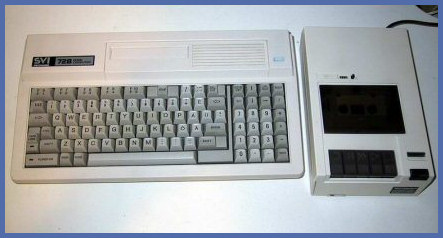

I have four main units (one CIB), four power adapter, two tape drive SVI-767 with power adapters, disk drive SVI707, MSX Softcard adapter and SVI-727 MSX 80 Column Cartridge.
type computer
country USA
year 1984
os MSX Basic v.1.0
cpu Zilog Z80 a
speed 3.58 MHz
ram 64 KB
vram 16 KB
rom 32 KB
graphic 256 x 192
colors 16
sound 3 channels, 8 octaves
ports centronics, tape, rgb, joystick (2), cartridge
The Spectravideo SV-728 is a classic piece of computing history, notable for being one of the first computers to embrace the MSX standard. Released in 1984, it served as a bridge between the early home computer era and the more standardized Japanese-led MSX movement.
A Pioneer of the MSX Standard
Before the SV-728, Spectravideo produced the SV-318 and SV-328. While those machines heavily influenced the MSX specifications, they weren’t fully compatible with it. The SV-728 was Spectravideo’s true entry into the MSX ecosystem, meaning it could run software and use peripherals designed for other MSX machines from brands like Sony, Panasonic, and Yamaha.
Technical Specifications
Under the hood, the SV-728 was a solid 8-bit machine for its time:
-
Processor: Zilog Z80A running at 3.58 MHz.
-
Memory: 64 KB of RAM (the maximum standard for MSX1) and 16 KB of Video RAM.
-
Graphics: Powered by the Texas Instruments TMS9918 chip, capable of a $256 \times 192$ resolution and 16 colors.
-
Audio: The General Instrument AY-3-8910 (PSG), providing three sound channels and one noise channel.
Design and Features
The SV-728 is easily recognized by its ”professional” look compared to its predecessors. It featured a high-quality, full-stroke mechanical keyboard, which was a significant upgrade over the ”chiclet” or rubber keys found on many budget computers of the era.
Connectivity
The machine was well-equipped for expansion:
-
Cartridge Slot: Located at the top for games and utility software.
-
Joystick Ports: Two ports for gaming.
-
Expansion Bus: Used for adding disk drives or extra interfaces.
-
Tape Interface: For loading software via standard cassette recorders.
Legacy
While Spectravideo was an American company, the SV-728 (and the MSX standard in general) found its greatest success in Europe, South America, and Japan. In Finland, the SV-728 was particularly popular, often remembered as many people’s first ”real” computer before the Commodore 64 or Amiga took over the market.
Today, the SV-728 is a prized item for retro-collectors due to its sturdy build quality and its role in the birth of the MSX platform.
The Spectravideo SVI-728 — The MSX Pioneer
The Spectravideo SVI-728 holds a uniquely personal significance in the Computer Museum Ata collection — it is directly connected to the MSX standard’s creation and represents a pivotal moment in computing history. Spectravideo, a Hong Kong company, produced the SV-318 and SV-328 computers in 1983 whose architecture directly inspired the MSX standard specification announced by Microsoft and ASCII on 27 June 1983. The SVI-728 was Spectravideo’s MSX-compatible machine, fully implementing the standard whose creation their earlier designs had influenced.
Spectravideo’s Role in MSX
The MSX standard was essentially a formalisation of what Spectravideo had already built into the SV-318 and SV-328 — using a Z80 processor, TMS9918 video chip, and AY-3-8910 sound chip in a configuration that Microsoft and ASCII used as the reference design for the MSX specification. This means that Spectravideo computers were functionally MSX-compatible before the MSX standard was formally announced, and the SVI-728 completed this circle by being a fully certified MSX machine from the company that had most directly influenced the standard’s creation.
Personal Connection
The Spectravideo holds special personal significance for this collection’s curator, Ari Tommiska, whose first computer was a Spectravideo — the machine that sparked the passion for computing that eventually led to Finland’s largest private retro computer collection. This personal history gives the Spectravideo machines in the collection a depth of meaning beyond their historical significance, representing the beginning of a journey that has spanned four decades of collecting.