
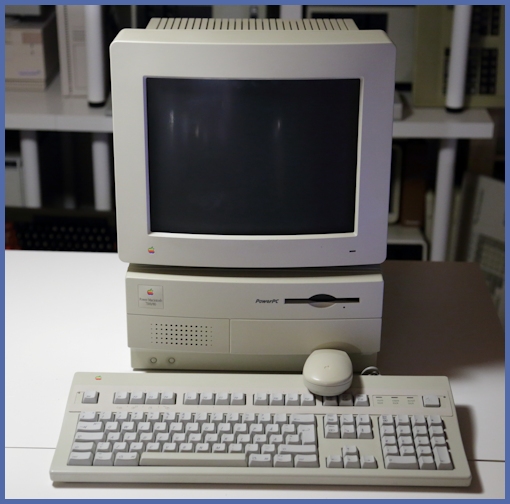
Applen Power Macintosh 7100/80
I have the main unit, AppleColor High-Resolution RGB Monitor, Apple
Extended Keyboard II and Apple Desktop Bus Mouse II.
type computer
country USA
year 1995
os Mac os 7.1.2-9.1
cpu Power PC 601
speed 80 MHz
ram 8 MB
rom 4 MB
hd 250 MB
graphic 832 x 624
colors 16 bit
sound yes
ports HDI-45, ADB, SCSI, serial (2), ethernet, microphone, sound out, power
The Apple Power Macintosh 7100/80 — The Mid-Range PowerPC Mac
Released in March 1994 alongside the 6100 and 8100, the Power Macintosh 7100/80 occupied the middle position in Apple’s first generation of PowerPC desktop computers. Running an 80 MHz PowerPC 601 processor in a minitower chassis with three NuBus expansion slots, it struck a practical balance between the entry-level 6100 and the professional 8100, targeting the broad range of creative professionals who needed expandable Mac capability without the expense of the top-of-the-line model.
The AIM Alliance
The PowerPC 601 processor at the heart of the 7100/80 was the product of the AIM alliance — a partnership between Apple, IBM, and Motorola formed in 1991 to develop a new RISC processor architecture that could challenge Intel’s dominance. The resulting PowerPC architecture was technically superior to Intel’s x86 in many respects, offering better performance per MHz, a cleaner instruction set, and a more efficient pipeline design. The 7100/80’s 80 MHz 601 delivered performance that comfortably exceeded anything available in the 68040 Mac lineup.
NuBus Expandability
The three NuBus expansion slots maintained compatibility with the large installed base of professional Mac expansion cards — an important consideration for users upgrading from 68040 Quadra machines who had invested in specialised graphics cards, video capture boards, DSP accelerators, and Ethernet cards. This backward compatibility helped smooth the transition to PowerPC for professional users who could not afford to replace their entire hardware ecosystem at once.
Historical Significance
The Power Macintosh 7100/80 represents a pivotal moment in computing history — one of the first machines to use the PowerPC architecture that Apple, IBM, and Motorola hoped would redefine the industry. While the PowerPC ultimately did not displace Intel in the PC market, it served Apple well for over a decade and produced some of the finest personal computers of the 1990s and early 2000s.