
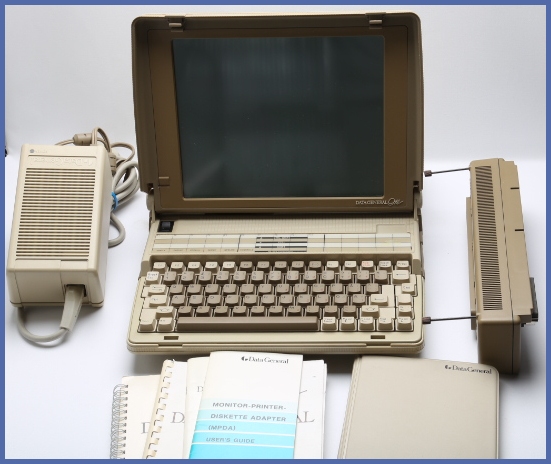
I have the main unit, power adapter and Data General Monitor-Printer-Diskette Adapter.
type computer
country USA
year 1984
os MS-DOS 2.11
cpu Intel 80C88
speed 4 MHz
ram 128K – 512K
graphic 11″ LCD 640 x 256
colors mono
sound beeper
disk 2 x 3.5″ 720K
ports modem, serial, parallel, system bus
The Data General/One — The Laptop That Set the Template
Released in September 1984, the Data General/One (DG-1) was the first truly portable, battery-powered IBM PC-compatible laptop computer — and the machine that established the clamshell design with LCD display and flat keyboard that every laptop has used ever since. eWeek described it in 2010 as ”the prototype for all that followed… with its LCD, flat keyboard and clam-shell case, this form factor has remained essentially the same for decades.” Despite only modest commercial success, the DG-1’s historical significance is profound: it defined what a laptop computer should look like.
Pioneer of the 3.5-inch Floppy
The DG-1 was the first portable computer to feature Sony’s new 3.5-inch floppy disk format — a decision that was simultaneously visionary and commercially damaging. Visionary because the 3.5-inch format would become the universal floppy standard for the next decade; damaging because in 1984 virtually no commercial software was available in that format, and copy-protection schemes made it impossible for users to copy their existing 5.25-inch software. Data General included a Monitor-Printer-Diskette Adapter to address this limitation, allowing connection to external 5.25-inch drives.
The Largest Portable Display of Its Era
The DG-1’s 11-inch monochrome LCD was the largest display ever fitted to a portable computer in 1984 — capable of displaying either a full 80×25 character text screen or CGA graphics at 640×200 pixels. Unfortunately, the display was not backlit and had notoriously poor contrast, earning a reputation for functioning better as a mirror than a screen in anything but ideal lighting conditions. This display limitation was the machine’s most criticised feature and contributed to its modest sales despite its impressive specifications.
Pierre Cardin Carrying Case
In a remarkable marketing decision, Data General included a carrying case designed by fashion designer Pierre Cardin — targeting style-conscious executives who wanted their portable computer to make a statement. At $2,895 base price (equivalent to nearly $9,000 today), the DG-1 was positioned as a premium executive tool, and the Cardin case reinforced this upmarket positioning. It remains one of the more unusual collaborations between the computing and fashion industries.
Legacy
The DG-1 set the physical template for the modern laptop that Apple, IBM, Compaq, and every subsequent manufacturer would follow. The Computer Museum Ata holds the main unit, power adapter, and the Data General Monitor-Printer-Diskette Adapter — a particularly complete example of a historically significant machine.