
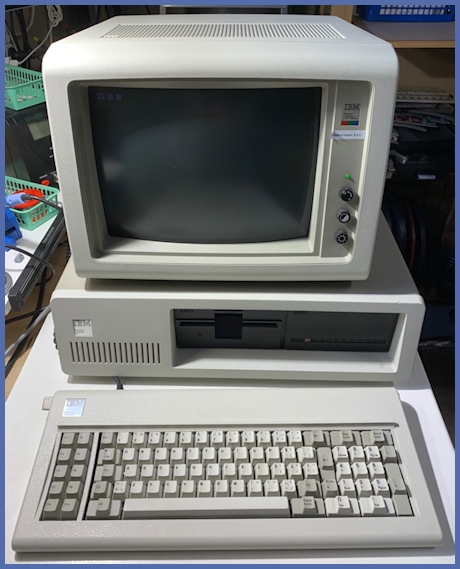
type computer
country USA
year 1986
os DOS 3.3
cpu Intel 8088
speed 4.77 MHz
ram 640 KB
disk 5,25″ 360KB
hd Seagate st-255 20MB
graphic 640×480
colors monocrome
sound peep
ports Monitor, keyboard, mouse, Centronics, rs323
The IBM PC XT — The PC Gets a Hard Drive
Released in March 1983, the IBM PC XT (eXtended Technology, model 5160) was the first IBM PC to include a built-in hard disk drive as standard — a 10 MB hard drive that transformed the PC from a floppy-based system into a genuinely capable business workstation. The XT also expanded the number of expansion slots from five to eight, provided 128 KB of RAM as standard, and included a second floppy drive. At $4,995 for the base configuration, it was expensive but offered business users the mass storage and expansion capability that the original PC had lacked.
The Hard Drive Revolution
The inclusion of a 10 MB hard drive changed how people used PCs fundamentally. Instead of carrying around a collection of floppy disks for different applications, users could install their software on the hard drive and access it instantly. Database applications, in particular, became far more practical — dBASE II, Lotus 1-2-3, and WordPerfect all benefited enormously from hard drive storage. The XT established the hard drive as an essential PC component, a status it maintained until solid-state drives began replacing it in the 2010s.
The XT Standard
The IBM PC XT became the template for ”XT-class” computers — a standard that persisted throughout the 1980s as the baseline for IBM-compatible machines. Clone manufacturers produced XT-compatible machines at increasingly competitive prices, driving down costs and expanding PC ownership dramatically. The XT’s eight ISA expansion slots became the standard configuration for desktop PCs, accommodating graphics cards, memory expansion, serial and parallel ports, and the growing range of peripherals that the expanding PC ecosystem demanded.