
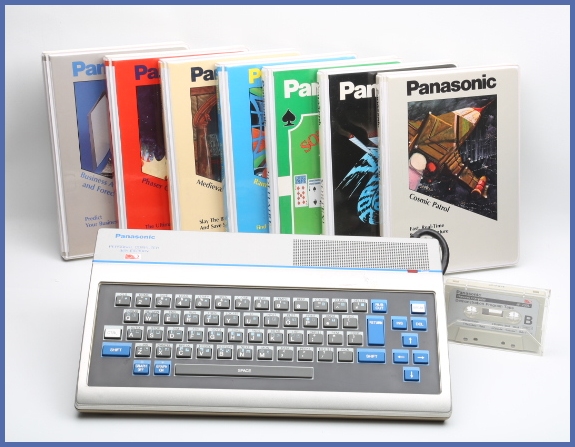
I have two main units.
type computer
country Japan
year 1983
os JR Basic 5.0
cpu MN1800A
speed 1 MHz
ram 32 KB
rom 16 KB
graphic 64×48
colors 8
sound 3 voices, 5 octaves
ports Composite video out, RF video out, RGB video out, Expansion bus, Tape (600/2400 bauds), RS-232c/printer port, External speaker
The Panasonic JR-200 — Panasonic’s Home Computer
The Panasonic JR-200UP was a home computer produced by Matsushita Electric in 1982 — a pre-MSX machine using a Motorola 6808 processor that was Panasonic’s own domestic home computer design before the company joined the MSX standard. The JR-200 offered colour graphics, a built-in BASIC interpreter, and a membrane keyboard in a compact case, targeting the Japanese home computer market that was rapidly developing in the early 1980s as consumers began to appreciate the possibilities of personal computing.
Before MSX
The JR-200 represents Panasonic’s home computing effort before the MSX standard was announced in June 1983 and reorganised Japanese home computing around a common specification. In the pre-MSX period, Japanese manufacturers including Panasonic, Sharp, NEC, Hitachi, and others each produced proprietary home computers with incompatible software libraries — a fragmented market that the MSX initiative attempted to resolve. The JR-200’s Motorola 6808 processor placed it in a different architectural tradition from the Z80-based machines that would dominate MSX.
A Transitional Machine
The JR-200 is historically interesting as a snapshot of Japanese home computing at the moment of transition — just before the MSX standard brought order to a chaotic market. Panasonic’s decision to join MSX and abandon the JR-200’s proprietary architecture in favour of the common standard reflected the rational economic calculation that compatibility was more valuable than differentiation for home computer manufacturers.