
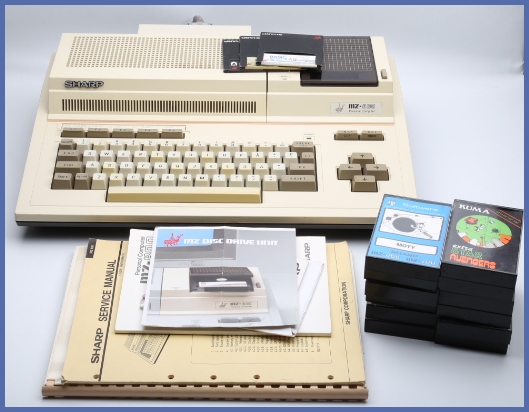
I have three main units, Sharp MZ-1E19 Disk Interface and two Sharp MZ-1F11 Quick-Disk Drive.
type computer
country Japan
year
os basic
cpu Zilog Z80A
speed 3.5 MHz
ram 64 KB
rom 32 KB
graphic 320 x 200
colors 13
sound 3 channels
ports tape, RF, video out, RGB, two joysticks
The Sharp MZ-800 (MZ-811 and MZ-821) — Sharp’s Clean Computer Evolution
The Sharp MZ-800 series, released in 1984, was the successor to the popular MZ-700 series — continuing Sharp’s distinctive ”clean computer” philosophy in a machine with significantly enhanced capabilities. The MZ-811 was the base model while the MZ-821 added a built-in Quick Disk drive. Using a Zilog Z80A processor at 3.5 MHz with 64 KB of RAM and 32 KB of ROM, the MZ-800 offered colour graphics at 320×200 pixels with 13 colours, three-channel sound, and a range of connectivity options including tape, RF, video output, RGB, and two joystick ports.
The Clean Computer Philosophy Continues
Like its MZ-700 predecessor, the MZ-800 maintained Sharp’s ”clean computer” approach — loading its operating system and software from external media rather than including a fixed BASIC in ROM. This design gave the MZ-800 remarkable flexibility: it could run multiple BASIC dialects, CP/M, and other operating systems by simply loading different software. The 32 KB of ROM contained a monitor program and basic I/O routines rather than a full operating system, keeping the machine genuinely open to different software environments.
Quick Disk — Sharp’s Storage Innovation
The MZ-821’s built-in Quick Disk drive used Sharp’s proprietary Quick Disk format — small, credit-card-sized flexible disks that could store approximately 64 KB per side. While Quick Disk was faster than cassette tape and more convenient than full-sized floppy disks, the format’s incompatibility with standard floppy disk systems limited software availability and ultimately contributed to its commercial failure. The MZ-1E19 Disk Interface and MZ-1F11 Quick-Disk Drive peripherals in the Computer Museum Ata collection provide a comprehensive picture of the MZ-800’s storage options.
Improved Graphics and Sound
The MZ-800’s graphics capabilities represented a meaningful improvement over the MZ-700 — 13 colours at 320×200 pixels provided richer visual output for both games and applications. The three-channel sound system delivered significantly better audio than the single-channel beeper of many contemporaries. These improvements made the MZ-800 a credible gaming and multimedia machine by Japanese home computer standards of 1984, while the clean computer architecture maintained its appeal to professional and educational users who valued software flexibility.