
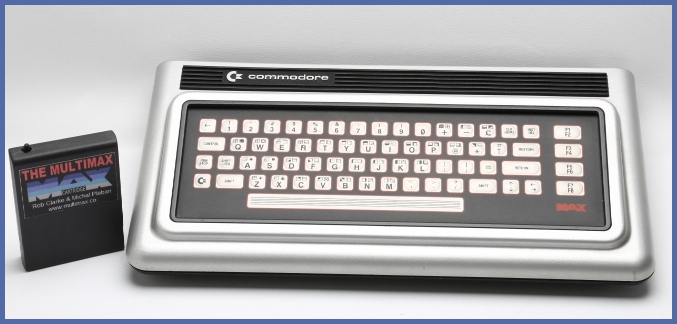
I have the main unit and Multimax -cartridge.
type computer
country USA
year 1982
os MAX Basic (cartridge)
cpu MOS Technology 6510
speed 1,02 MHz
ram 2 KB
graphic 320 x 200
colors 16 colors
sound yes
ports power, audio, expansion port, RF, casette, joysticks (2)
The Commodore MAX Machine — The Gaming Commodore
Released in Japan in 1982 under the name MAX Machine (and also known as the Ultimax in North America and VC-10 in Europe, though it was never officially released in those markets), the Commodore MAX Machine was a stripped-down, game console-oriented computer that shared much of its architecture with what would become the Commodore 64. Using the same MOS 6510 processor, VIC-II graphics chip, and SID sound chip as the C64, the MAX offered impressive gaming capabilities at a lower price — but with only 2 KB of RAM and no built-in keyboard, it was essentially a game cartridge system that could be expanded into a computer.
The C64 Connection
The MAX Machine is historically significant as the machine that proved the SID and VIC-II chips in a commercial product before the C64 launched. The chips designed for the MAX were recycled into the C64 design, making the MAX something of a technical proving ground for Commodore’s most successful product. Software cartridges designed for the MAX were compatible with the C64 (though not vice versa), and some early C64 games originated as MAX cartridges.
Japan-Only Release
The MAX Machine was sold exclusively in Japan, where it competed against home gaming systems from Nintendo, Epoch, and other Japanese manufacturers. It was not a commercial success — the Japanese market preferred dedicated consoles with larger software libraries, and the MAX’s limited 2 KB of RAM severely restricted what software developers could create. Production was brief, making surviving examples rare outside Japan. The Computer Museum Ata’s example is a particularly notable collector’s piece given this rarity.
Legacy
The MAX Machine is today one of the most sought-after Commodore rarities, valued both for its direct connection to the C64’s development and its scarcity. It represents a road not taken — Commodore’s brief exploration of the dedicated gaming console market before committing fully to the C64 as their primary product.